Posted by Michele Mele 06 June 2026
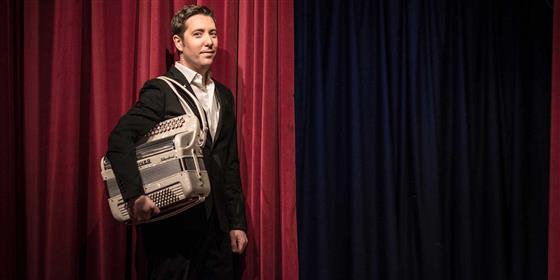
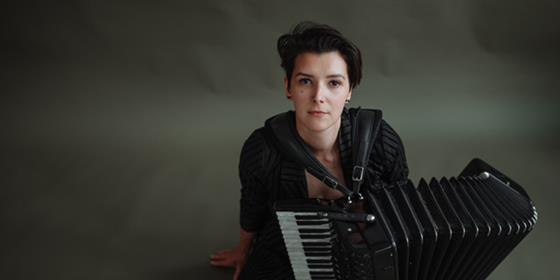
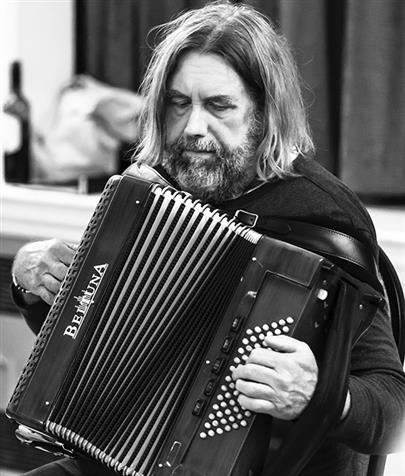
Accordion maestro Paul Hutchinson is undoubtedly one of the most recognised artists on the British folk scene. His career spans four decades and includes both acclaimed solo works and many pivotal projects, the most famous of which is Belshazzar’s Feast with Paul Sartin.
His repertoire is deeply rooted in 17th and 18th century English country dances and traditional music, but his original compositions and his trademark playing style incorporate elements from many other genres, particularly jazz and classical music, as evident in his work with Pagoda Project, Coracle and Hoover the Dog. His fame extends far beyond his native country, as shown in his many international collaborations with artists such as Belgian balfolk duo Naragonia, Swedish acoustic folk and roots band Väsen, American pianist and accordionist Karen Axelrod and Australian cellist Allye Sinclair.
He has been so kind as to answer a few questions for Bright Young Folk readers.
Your father famously encouraged you to take up the accordion at the age of 17 as a practical joke, that became a defining moment for your whole life. When you first picked up the instrument, did you immediately see it could be a companion for your life and career? Or did this appreciation grow later?
My ambition was to become a morris dancer (honestly) and went along to join a new team, Twynham Morris in Christchurch. They had young and willing dancers but no musicians, but knowing my dad owned an accordion they pressganged me into borrowing it for the next practice so I could play for them. I never looked forward…
You are often praised for bringing a distinctive lightness of touch to an instrument that is sometimes stereotyped as just a boisterous and loud one. How did you develop your specific refreshing sound? And who were the artists that had the greatest influence on your playing?
Great question! I learned to play the traditional way, fast, loudly and with the repetitive accompaniment which seems to be the default style of many accordionists.
My eureka moment came when I went to see The Bothy Band in London many years ago. during their first number a guy was sat at the front of the stage with a what looked like a set of plumbing tools. These turned out to be the Uillean pipes and when he joined in with a low drone, it made the hairs on the back of my neck stand up.
Thereafter I was heavily influenced by instruments other than the accordion. As a church organist in my teens, I attempted to simulate the church organ by playing single bass notes on the left hand, and on the keyboard side the treble, alto and tenor parts. I am not a huge fan of the left hand prescriptive chords and wanted to create more space in the music, so a few years ago I had my 7th row surgically removed and replaced by 5ths. The result is that my accompaniments have more space.
Other major influences include Martin Hayes for his Baroque approach to Irish music, Chris Wood and Andy Cutting who opened my ears to three dimensional arrangements and space in their music.
You have a well-documented passion for 17th and 18th century social dance music culminating in many albums and in your book “Sixty country tunes 1786-1800”. What is it about the music of this era that speaks to your heart so strongly? And how do you approach breathing a new life into these old dusty manuscript pieces?
Playing for historic dance eg Playford music, was Belshazzar’s Feast’s way into the folk scene. Paul Sartin and I both had classical backgrounds and some of these Playford tunes are beautifully crafted, composed by the likes of Handel, Purcell and Clarke. There are also a lot of ’mock Tudor’ tunes which are less beautifully crafted (!) so it became a mission to breathe new life into them.
Halsway Manor encouraged me pass this on. The course called The Maniacs was designed to take ordinary tunes on a journey and develop them by changing the modes and time signatures for example.
If you had to name a traditional tune or a set in one of your albums, the one that best summarises your distinctive take on centuries old material, what would it be?
I think the dance tune A Trip to Marrowbone better known as Four Bare Legs and/or my take on Tollett’s Hornpipe. Trip to Marrowbone has become a tango and Tollet’s, rather Scandi.
For 25 years, you were half of the incredibly beloved duo Belshazzar’s Feast alongside the late, great Paul Sartin. Beyond the beautiful music, you both became famous for your wit and onstage humour. How important do you think that element of comedy and connection is to the live folk music experience?
Paul and I always maintained that we never took ourselves seriously, but (believe it or not) we did take the music seriously. We were employed to entertain and so humour was one way of putting us and the audience at ease. Laughter is best medicine and also we thoroughly enjoyed moving an audience with winners such Home Lad.
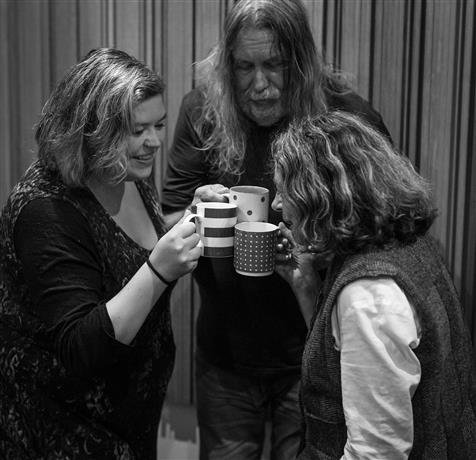
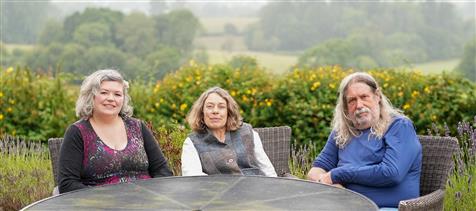
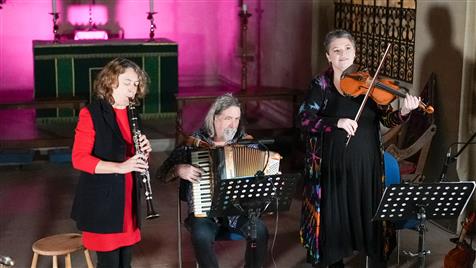
Your recent work with Pagoda Project, alongside clarinet virtuoso Karen Wimhurst and fiddler Hannah Cumming, is receiving rapturous responses for its intricate yet genuine feel. How did this new project start? Is there a reason behind the trio’s name?
Karen and I were recruited to join a band formed by John Hymas (Hoover the Dog) called Big Top, more than 15 years ago. Due to the logistical nightmare of keeping a 7-piece band together when we lived all over the country, it didn’t last long. But Karen had just created a project about the demise of orchards and asked me to join. We enjoyed the musical danger and we performed as a duo for a few years.
It’s not the case now (thanks Leveret), but then instrumentalists without songs were less popular even though our debut duo album won us 5* reviews in FRoots and Songlines. So we looked for a vocalist/instrumentalist and Anna Tam (Mediaeval Baebes) joined us (Coracle) before leaving us to work with Max Richter and live in Barcelona!
After a few months of treading water, I asked Hannah to join us. I had known Hannah for years but this has turned out to be one of my most inspirational ideas.
I think any musician will know how difficult it is to find a name, I happened to be in Kew Gardens when I saw the Pagoda. I realise this isn’t very exciting…
As one of the most sought-after educators and workshop leaders, including your work with the English Folk Dance and Song Society, what is the single most common piece of advice you find yourself giving to your students?
Choosing one is quite difficult, maybe it is listen to what you are doing and every note counts. The expression ’it’s good enough for folk’ really isn’t good enough. Amen
What are your plans for the future?
The continuation with Pagoda Project - please see our website for dates (www.pagodaprojectband.com)
I did one gig with Gabi Maas (nycelharpa/violin) last year which was so much fun and so that is in the pipeline.
Plans are also underway for an educational podcast about the true ’back stories’ of well-known tune titles.
See all of Bright Young Folk's text interviews.